Get Informed — File No. 04
The voters have already left the parties.
Both parties are underwater with the public. Independents lead voter self-identification in a majority of states and have outnumbered either party nationally since 2009. The mechanics of a two-party monopoly no longer match the electorate it claims to represent.
Exhibit A
Parties underwater with all.
Net favorability of both parties is negative, and independents rate them lowest of all.
| −17% | Democrats underwater: 37% favorable, 54% unfavorable | NORC/Gallup/USA Today |
| −34% | Republicans underwater: 30% favorable, 61% unfavorable | NORC/Gallup/USA Today |
| −34% | independents' view of BOTH parties: 8% favorable, 42% unfavorable | NORC/Gallup/USA Today |
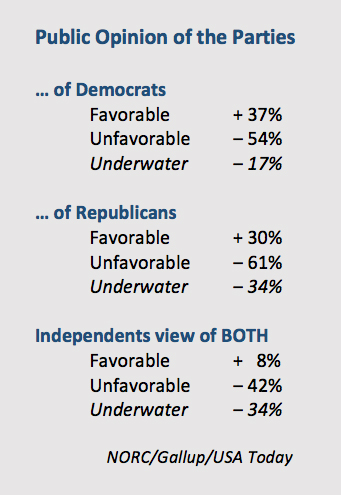
Exhibit B
Independents dominate where voters self-identify.
In 27 states plus D.C., independents rank first, second, or within 10 points in voter self-identification.
| 10 | states where independents rank #1 over BOTH parties: AK, AR, CO, CT, IA, ME, MA, NH, NJ, RI | UVA Ctr. for Politics |
| 8 | states where independents rank #2, over Ds or Rs: AZ, CA, ID, KS, NC, OR, UT, DC | UVA Ctr. for Politics |
| 9 | states where independents rank #3 but within 10%: DE, FL, LA, MD, NE, NM, NY, SD, WY | UVA Ctr. for Politics |
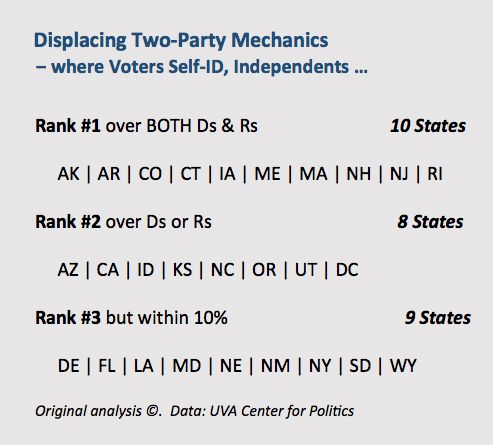
Exhibit C
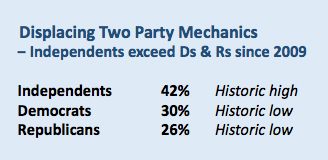
Independents are already a third force.
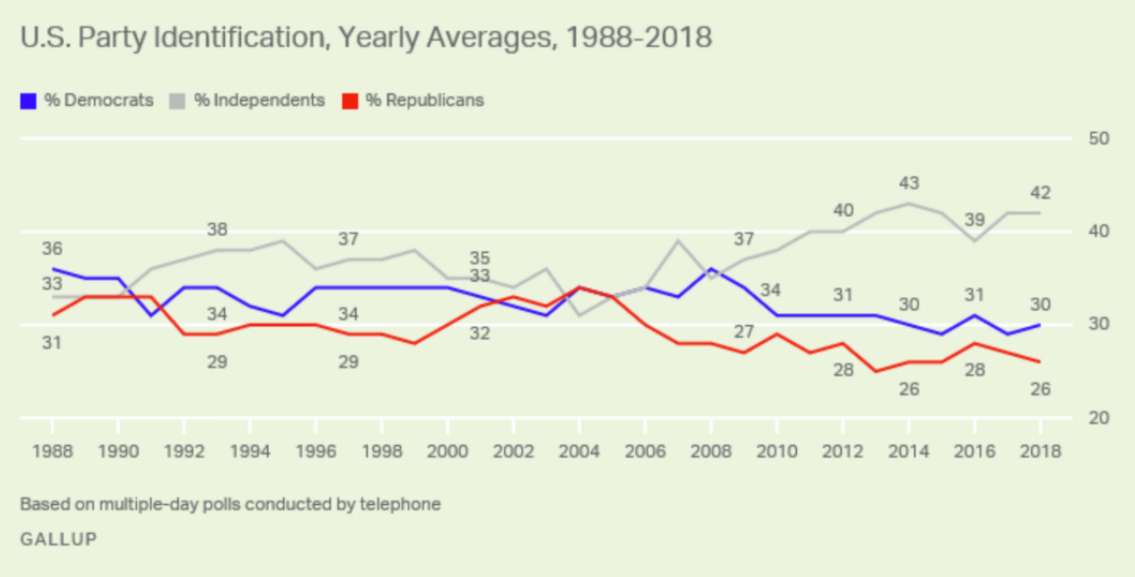
Independents have exceeded both Democrats and Republicans since 2009, and the gap keeps widening.
| 42% | of voters self-identify as independents, a historic high | Gallup |
| 30% | self-identify as Democrats, a historic low | Gallup |
| 26% | self-identify as Republicans, a historic low | Gallup |
Next
A plurality without a mechanism.
Forty-two percent of voters stand outside both parties, with no machinery of their own. The initiative exists to give that public a working one. See why it is needed, and what it is.